

Please select your location and preferred language where available.
UFS 3.1 for Automotive
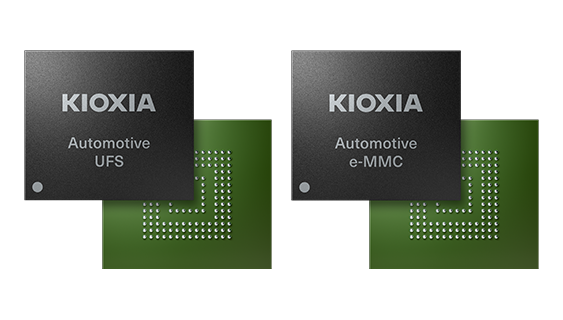
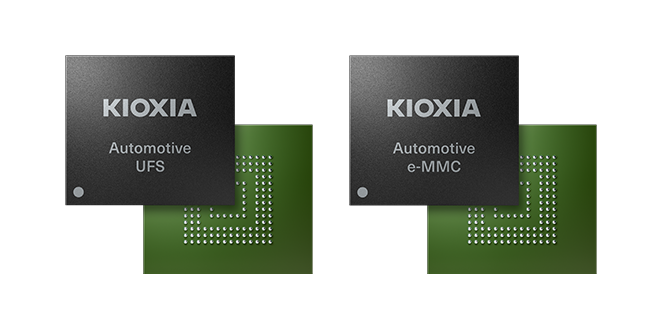
Key KIOXIA Automotive UFS 3.1 Features
- Compliant with IATF16949
- Meets automotive standards (e.g., AEC-Q100 Stress Test Qual Standard)
- Supports PPAP (Production Part Approval Process)
- Extended Temperature Range (e.g., -40°C to +105°C)
- Low Failure Rate
- Longer lead time for PCN compared to non-automotive grade parts
- Features for automotive (e.g., enhanced solder ball reliability, countermeasures if chip exceeds certain temp, etc.)
- 64GB, 128GB, 256GB, 512GB
Next Generation UFS 4.0 / 4.1 for Automotive
KIOXIA UFS 4.0 / 4.1 automotive devices deliver enhanced capabilities to support increasingly sophisticated automotive applications. With an interface speed of up to 46.4Gbps and a range of density options, the new UFS 4.0 / 4.1 automotive devices are well-suited to support the next generation of complex automotive applications.

The Changing Interface from e-MMC (parallel) to UFS (serial)
UFS was specifically defined by JEDEC to be the high-performance memory replacement for e-MMC. It has become the premiere solution for smartphones, continuing to migrate into automotive and other applications. UFS will ultimately surpass e-MMC as the primary storage solution for automotive applications.
UFS Market Trend
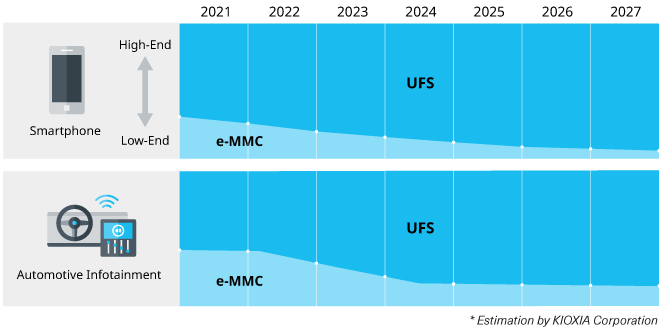

UFS is the faster performance JEDEC standard replacement to e-MMC. Smartphone adopted UFS for its performance advantages. Automotive is doing the same.
Why UFS?
Simply put – it’s the successor to e-MMC. UFS performance will continue to advance, significantly widening its performance advantage over e-MMC.
Compared to e-MMC, UFS Delivers:
- A faster interface
- Higher performance for reads and writes
- Higher density offerings
- Better power efficiency
Boot Time Comparison (64MB Data-out)
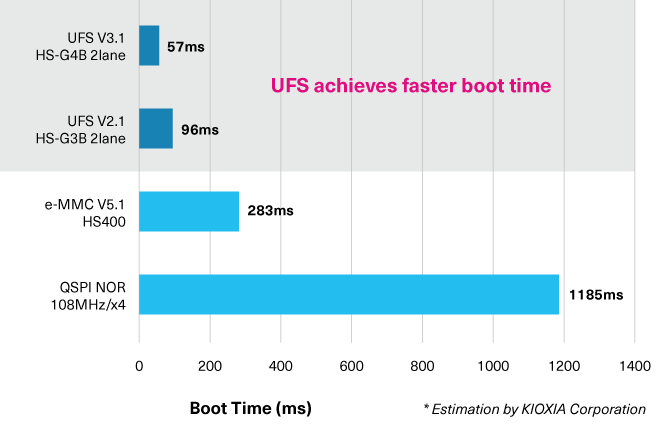
Faster boot time with a large amount of boot data is a big motivation to use UFS in automotive applications.
UFS has a faster boot time than other storage devices thanks to its high speed sequential read.
Additional Automotive UFS Features Well-Suited for Automotive Reliability
- Thermal Control: If the device exceeds 105°C, the device slows the performance and notifies the host processor to take action
- Extended Diagnosis: the UFS controller monitors various items, such as write/erase cycles, current temperature, etc. and reports device status to the host processor
- Refresh: enables refresh of deteriorated data, improving data reliability.
KIOXIA has led the way in UFS since 2013, being first to sample the technology*,
and will continue to pave the road ahead for automotive applications of the future.
* As of February 8, 2013. KIOXIA survey.
Automotive UFS 3.1 Specs
AEC-Q100 Grade 2(1)
*Table can be scrolled horizontally.
| Capacity | Part Number | UFS version |
Max Data Rate (MB/s) |
Supply Voltage | Operating Temperature (℃) (2) |
Package Size (mm) |
||
|---|---|---|---|---|---|---|---|---|
| VCC (V) |
VCCQ (V) |
VCCQ2 (V) |
||||||
| 64GB | THGJFGG9T15BAB8 | 3.1 | 2320 | 2.4 to 2.7, 2.7 to 3.6 |
1.14 to 1.26 | - (3) | -40 to 105 | 11.5x13.0x1.2 |
| 128GB | THGJFGT0T25BAB8 | |||||||
| 256GB | THGJFGT1T45BAB8 | |||||||
| 512GB | THGJFGT2T85BAB5 | 11.5x13.0x1.3 | ||||||
- Electrical component qualification requirements defined by the AEC (Automotive Electronics Council).
- Tc=115℃ max.
- This product supports dual-supply operation at VCC and VCCQ. VCCQ2 need not be supplied.
- In every mention of a KIOXIA product: product density is identified based on the density of memory chip(s) within the product, not the amount of memory capacity available for data storage by the end user. Consumer-usable capacity will be less due to overhead data areas, formatting, bad blocks, and other constraints, and may also vary based on the host device and application. For details, please refer to applicable product specifications. The definition of 1KB = 210 bytes = 1,024 bytes. The definition of 1Gb = 230 bits = 1,073,741,824 bits. The definition of 1GB = 230 bytes = 1,073,741,824 bytes. 1Tb = 240 bits = 1,099,511,627,776 bits.
Support

Please contact us if you have any technical questions, requests for materials, are interested in samples or purchases of business products (Memory, SSD), etc.

In 2007, KIOXIA announced the world‘s first 3D flash memory technology. Presenting our cutting-edge technologies, along with the key points of innovation and our efforts toward further increases in capacity.

KIOXIA invented the world’s first NAND flash memory in 1987. This is an explanation of the structure of flash memory and the mechanism of data storage.


